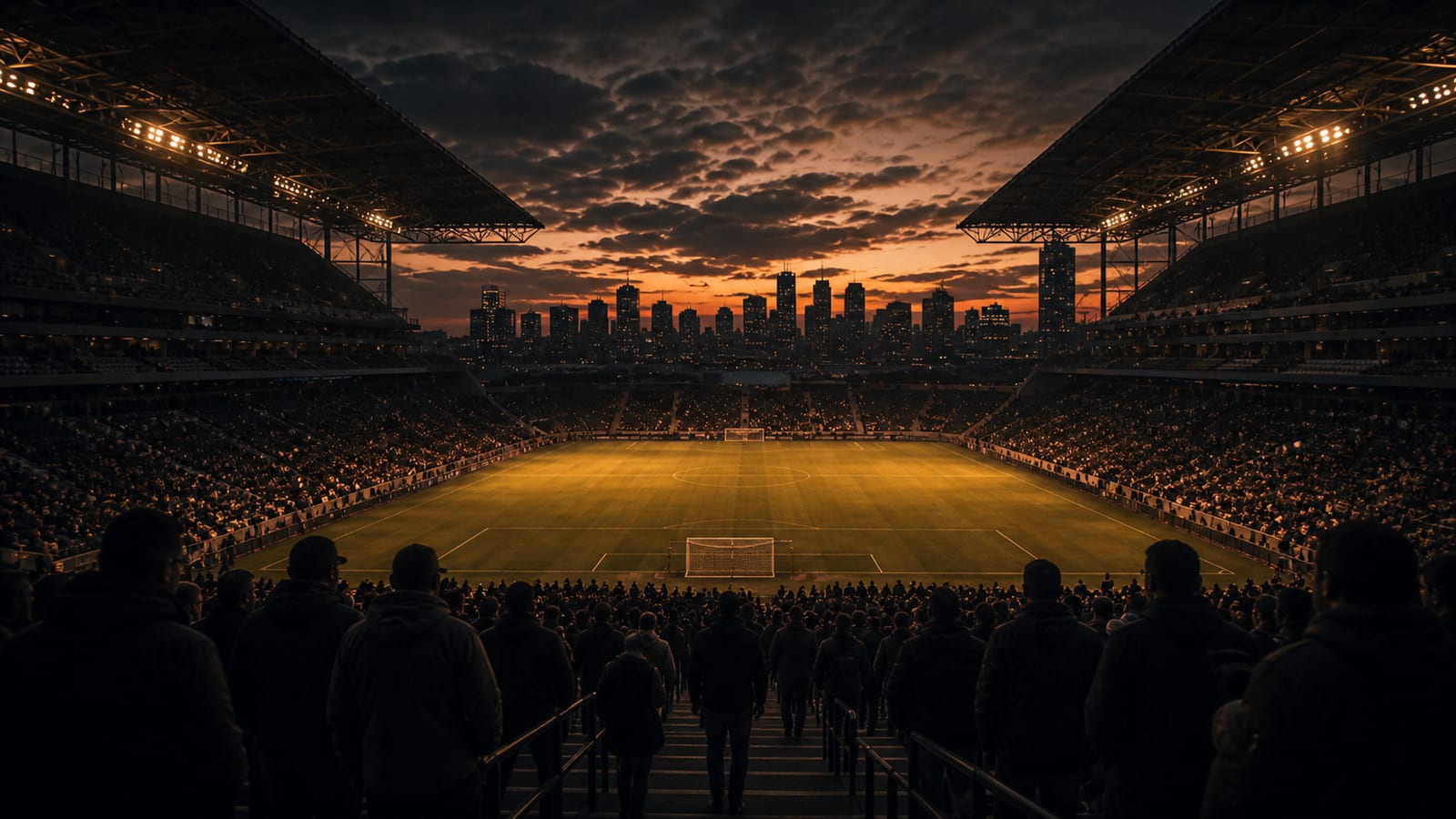
This guide covered all sixteen host cities through the build-up. Most are now finished hosting – Toronto, Philadelphia, Houston, San Francisco, Guadalajara and Monterrey have played their last matches, and if you're still in one of them you're a tourist now, not a fan. What follows is the updated picture for the ten cities still in play, plus a longer section on the final weekend in New York and New Jersey, where the tournament's remaining safety questions concentrate.
Where the tournament is now
The round of 16 runs to 7 July. The quarter-finals are 9–11 July in Boston, Los Angeles, Miami and Kansas City. The semi-finals are at AT&T Stadium in Dallas on 14 July and Mercedes-Benz Stadium in Atlanta on 15 July. Miami hosts the third-place match on 18 July, and the final is at MetLife Stadium in East Rutherford, New Jersey, on Sunday 19 July.
One structural point: from 8 July onwards, every remaining match is in the United States. Mexico's hosting duty ends tonight with Mexico against England at the Estadio Azteca, and Canada's ends on 7 July with Switzerland against Colombia in Vancouver. The final fortnight is an American event, which simplifies some planning and concentrates the crowds.
The knockout cities, match by match
Mexico City – tonight, then Mexico is done
Mexico against England at the Azteca is the last World Cup match on Mexican soil this tournament. Guadalajara finished with the group stage – its four matches were all groups, no knockouts – and Monterrey's last game was a round-of-32 fixture on 29 June. Both cities came through their hosting without the cartel flare-up we were watching for in May, though Guadalajara is still the Mexican city to monitor if you're staying on.
For tonight: the advice from the group stage holds. Base yourself in Polanco, Roma Norte, Condesa or Coyoacán, use Uber rather than street taxis, and treat the Metro after the final whistle as a pickpocketing event with trains attached. An Azteca crowd of 83,000 emptying simultaneously into a city of nine million is about as dense as crowd movement gets; the streets around the stadium will take two hours to drain whoever wins. If you're staying on in Mexico after tonight, the full picture is in our Mexico guide.
New York and New Jersey – a round-of-16 tie tonight, then the final
The final's own venue is in play tonight: Brazil against Norway at MetLife Stadium, 4pm Eastern. The rail arrangements described in the final-weekend section below – the 40,000-ticket cap, the wristband, the advance purchase on the NJ Transit app – apply on every MetLife match day, tonight included. If you're going, read that section now.
Dallas – a round-of-16 tie and a semi-final
AT&T Stadium in Arlington hosts Portugal against Spain on 6 July and then a semi-final on 14 July – nine matches in total, more than any venue in the tournament. The crime picture remains unremarkable. The heat does not. Dallas in mid-July sits in the mid-to-high 30s most afternoons – 40°C in a heatwave – and the semi-final's 2pm local kickoff means queuing, tailgating and the walk from distant parking all happen in the worst of it. The stadium is air-conditioned; the two hours either side of the match are not. Treat hydration as a task, not a preference.
Seattle and Vancouver – one match each
Seattle hosts the United States against Belgium on 6 July, the loudest home crowd of the tournament and the one where post-match streets will be most emotionally charged either way. Belltown, Capitol Hill and Queen Anne remain the sensible bases; the realistic risk remains property crime, plus wildfire smoke if regional fires pick up.
Vancouver closes the round of 16 (and Canada's tournament) with Switzerland against Colombia on 7 July. Minimal crime risk in the tourist core; the standing advice about detouring around East Hastings between Main and Gore still applies.
Atlanta – a round-of-16 tie and a semi-final
Argentina against Egypt on 7 July, then the second semi-final on 15 July. An Argentina match means a large travelling crowd and dense downtown fan areas. The two disruptions to plan around are the ones we flagged in May: traffic and summer thunderstorms, either of which can wreck a match-day timetable. Stay in Midtown, Buckhead or the Old Fourth Ward. The airport is the world's busiest and semi-final week will strain it; three hours early remains the floor.
Boston – quarter-final, 9 July
The first quarter-final is at Gillette Stadium in Foxborough, about twenty-two miles southwest of the city most fans will sleep in. Boston stays one of the safer big American cities; the problem is entirely logistical. Route 1 around the stadium congeals for hours either side of kickoff, and the trains and shuttle buses will be oversubscribed. If you're driving, four hours before kickoff is a considered arrival time, not a paranoid one.
Los Angeles – quarter-final, 10 July
SoFi Stadium in Inglewood. The rule on rental cars has not changed and will not: anything visible inside the car will be gone when you return, so leave nothing, not even a charging cable. Base yourself in Santa Monica, West Hollywood, Culver City or Pasadena. Match-day driving will be brutal; the metro connection plus shuttle is slower but calmer. Check air quality before any open-air fan event – July is fire season.
Miami – quarter-final on 11 July, third-place match on 18 July
Miami has the longest remaining hosting run outside New York, and the fullest set of risks. Petty crime in South Beach and drink spiking in clubs are the realistic ones; base yourself in Brickell, Coral Gables or mid-Beach. The weather risk is now live rather than theoretical – mid-July is properly inside hurricane season, and a named storm approaching during third-place week would disrupt flights days before it disrupted anything else. Weather-disruption cover on your insurance is still the move.
Miami is also, not coincidentally, where US Customs seized 8,400 counterfeit Nike World Cup jerseys in mid-June – more on counterfeits below, because the problem follows the tournament and it is heading north for the final.
Kansas City – quarter-final, 11 July
Arrowhead's knockout match closes the quarter-final round. KC remains friendly and manageable, with visible security shaped by the 2024 parade shooting. The genuine problem is getting out afterwards: Kansas City has fewer flight connections than any other remaining host city, and the post-quarter-final exodus will fill them. If your onward travel isn't booked yet, do it today.
The final weekend: New York and New Jersey
More than 1.2 million visitors are expected in the New York area across the tournament, with the heaviest concentration in the final week – most of them without tickets. Three specific problems deserve more than the general advice.
The transit crush
MetLife Stadium's rail link is the tournament's most engineered chokepoint. NJ Transit has capped match-day rail tickets at 40,000 per match, sold in advance through its app – if you intend to take the train, buy the rail ticket as soon as you have the match ticket, because there is no turning up and buying one on the day once the cap is hit. The dedicated stadium service starts around four hours before kickoff. Ordinary commuter trains keep running between New York Penn Station and Secaucus Junction for everyone, but at Secaucus you pass a security screening and collect a wristband, and the connecting train to the stadium is wristband-only – the agency's own slogan is "No Wristband, No Ride". Bags are the enemy of this system – NJ Transit's own police chief has been telling fans to carry as little as possible, because most of it isn't allowed in the stadium anyway.
The return journey is the harder one. The agency is deliberately trying to avoid a repeat of the 2014 Super Bowl, when departing crowds overwhelmed the platform, and its answer is a fan zone at the stadium kept open for three hours after the final whistle to stagger departures. Use it – the same train an hour later, without the crush, is the better deal. Do not drive to MetLife for the final, and do not book a flight out of any New York airport before midday Monday.
Away from the stadium, the standing advice holds: pickpocketing on the subway and in Times Square, and phone-snatching from bikes and mopeds. Keep the phone zipped between uses.
Ticket scams in the resale scramble
The final is where desperation meets fraud. The FBI's Internet Crime Complaint Center put out a public warning in late May about spoofed FIFA websites and fake ticket portals built to harvest card details and sell tickets that don't exist, and the volume of both rises with every knockout round.
The structural fact to understand is that FIFA tickets for this tournament are mobile-only and can only be transferred through the official FIFA ticketing app. A PDF is not a ticket. A screenshot is not a ticket. A seller who proposes any transfer mechanism other than the app – email, AirDrop, "I'll meet you at the gate" – is describing a scam, whatever the profile photo looks like. Some scalpers list tickets they haven't bought; some sell the same ticket twice; FIFA can void improperly transferred tickets at the turnstile, which means you can be holding something genuine and still not get in. If you're buying at this stage, use FIFA's official resale platform and nothing else, and treat anything on Facebook Marketplace, Telegram or WhatsApp as a donation. We keep a running file on the current variants in travel scams in 2026.
Counterfeit merchandise
In the first week of match play alone, US Customs and Border Protection recorded more than 1,400 World Cup-related seizures – fake jerseys, balls, even FIFA-branded electronics – worth over $23 million at genuine retail prices, with the Miami jersey haul and a $6 million seizure at the Port of Houston the headline items. Whatever got through is now on folding tables outside every remaining venue, and the density will peak on the approaches to MetLife.
A fake jersey is a consumer decision we don't propose to police. The actual safety point is the payment: a pop-up stall is an unvetted stranger with a card reader, and final-weekend crowds are where cloned-card fraud does its best work. If you buy from a street table, pay cash, and keep the contactless card in the zipped pocket.
What still applies
The group-stage fundamentals haven't changed, so briefly. Petty crime spikes wherever fans concentrate; wear something cross-body and use ATMs inside bank branches. The US mass-shooting guidance is unchanged: Run, Hide, Fight, in that order, and never stop to film. Heat is still the most likely thing to actually hurt you – Dallas, Atlanta, Kansas City and Miami in mid-July can all put an unprepared fan in a medical tent. The thirty minutes after a match remain when most fan crime happens: stay with the crowd, use designated rideshare zones, and never get in a car that approached you.
Advisory levels for all three host countries are unchanged since the tournament began – you can check the current government positions for the United States, Canada and Mexico on their country pages, and any mid-tournament changes appear in our changes feed.
How to find out about something the moment it happens
The most useful thing you can do for your own safety in the next fortnight is shorten the gap between something happened and you know about it. That gap is what turns a manageable situation into a dangerous one: you walk into a fan zone an hour after a security incident, or your train line closes mid-journey.
That's the gap Warnely closes. We monitor every remaining host city and push notifications within minutes of an incident becoming public. Free for all World Cup cities through the end of the tournament; the live feed is on our news page.
Fourteen matches remain in the largest sporting event ever staged. The fans who have a bad final fortnight will mostly be the ones who didn't know about a risk that was knowable.
Last updated: 5 July 2026. Sources: FIFA match schedule, NJ Transit regional mobility plan, FBI IC3 public service announcement of 27 May 2026, US Customs and Border Protection seizure notices, US State Department and UK FCDO advisories, and Warnely's own incident database.